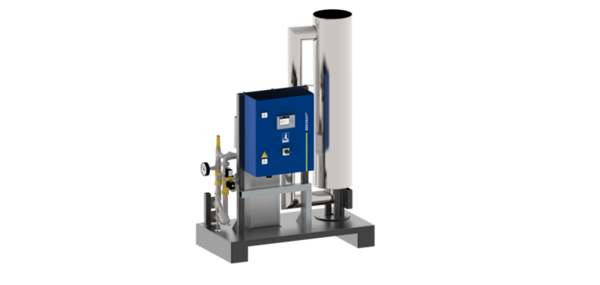
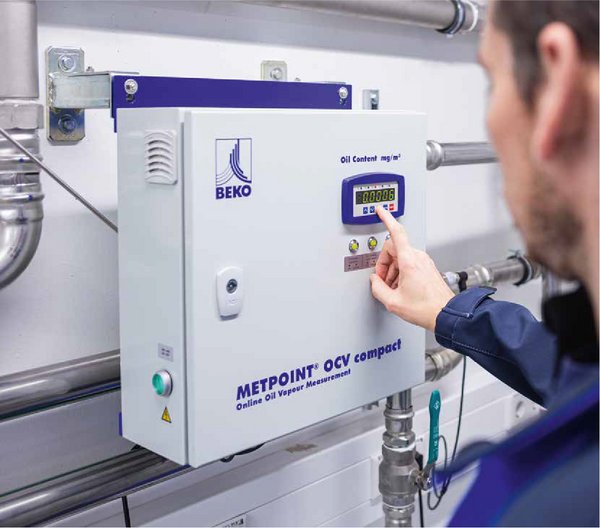
The above performance data apply to the following operating conditions: 7 bar, relative humidity 30%. By connecting several activated carbon adsorbers in parallel, respective higher volume flows can be processed. Versions available: VIM, VWM, VWMX, V
CLEARPOINT V
Active-Carbon-Adsorber
Economic oil-free compressed air with activated carbon adsorbers
complete solution with oil-free dust filter low operating costs for residual oil content of max. 0.003 mg/m³

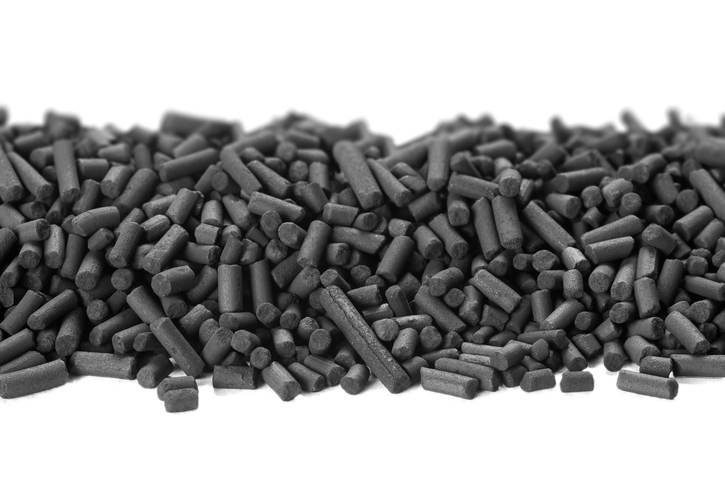
Compression-moulded activated carbon pellets for high compressed air quality
In order to ensure high compressed air quality with compressed air class 1-2 in accordance with ISO 8573-1, in particular with regard to the residual oil content, the CLEARPOINT V activated-carbon adsorber is the effective and reliable technical component in demanding system designs.
The consistent overall concept guarantees compressed air quality with a minimum residual oil content extremely cost-efficiently. Oil vapours and odours are adsorbed on the unusually large active surface of the compression-moulded activated carbon pellets. When selecting our activated carbon, we work together with selected suppliers who guarantee consistent carbon quality. A major advantage for your compressed air quality and process reliability.
How does compressed air become oil-contaminated?
Particles, oil aerosols, germs and moisture can enter the compressed air system in many ways – often already via the ambient air drawn in by the compressor. Nearby roads, industrial plants or construction sites increase the risk of contamination. High ambient humidity also raises the moisture content in the compressed air.
This contamination poses a double risk: it accelerates wear and malfunctions in the compressed air system and at the same time jeopardises product quality – and ultimately consumer safety.
How does the activated carbon adsorb the oil in the compressed air?
Find out how activated carbon works in the field of compressed air treatment and what is important when you have an activated carbon adsorber in operation in your compressed air network.
Your benefits at a glance
Economical
- low operating costs
- low differential pressure
- long service life
Efficient
- efficient oil vapour adsorption with special activated carbon for max. residual oil content of 0.003 mg/m³
- complete solution with oil-free dust filter
Adaptable
- oil test indicator or
- METPOINT OCV compact - residual oil content monitoring to safeguard production processes
Flexible solutions for different flow rates
While BEKOKAT is designed for applications with very high oil vapour loads and the highest purity requirements, CLEARPOINT V in sizes S/M and L is the efficient solution for standard operating conditions and a wide range of flow rates. Depending on the compressed air volume required, BEKO TECHNOLOGIES offers you suitable solutions:
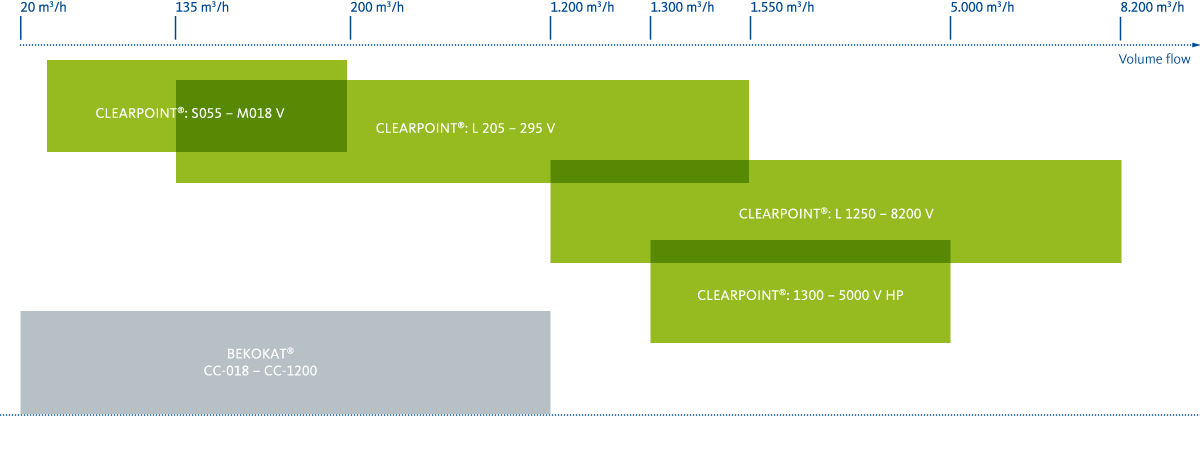
Parallel configuration for maximum performance
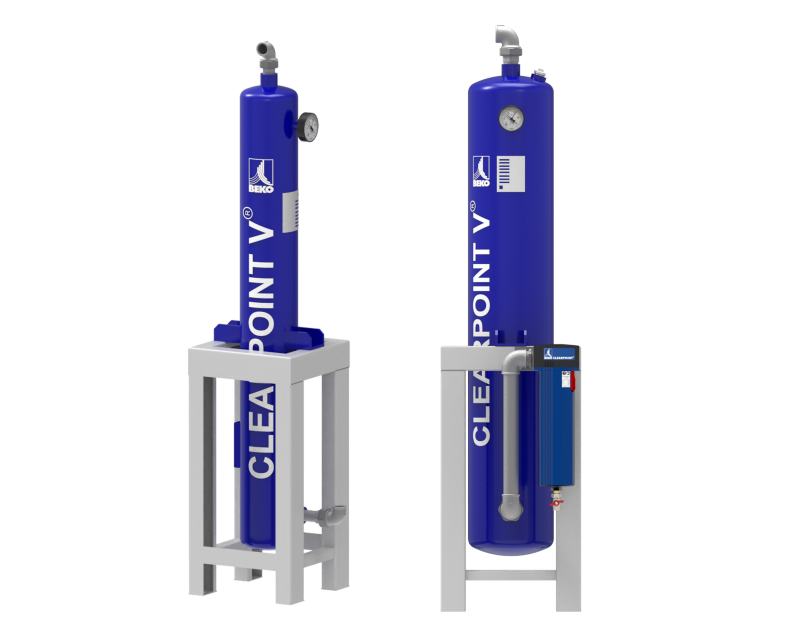
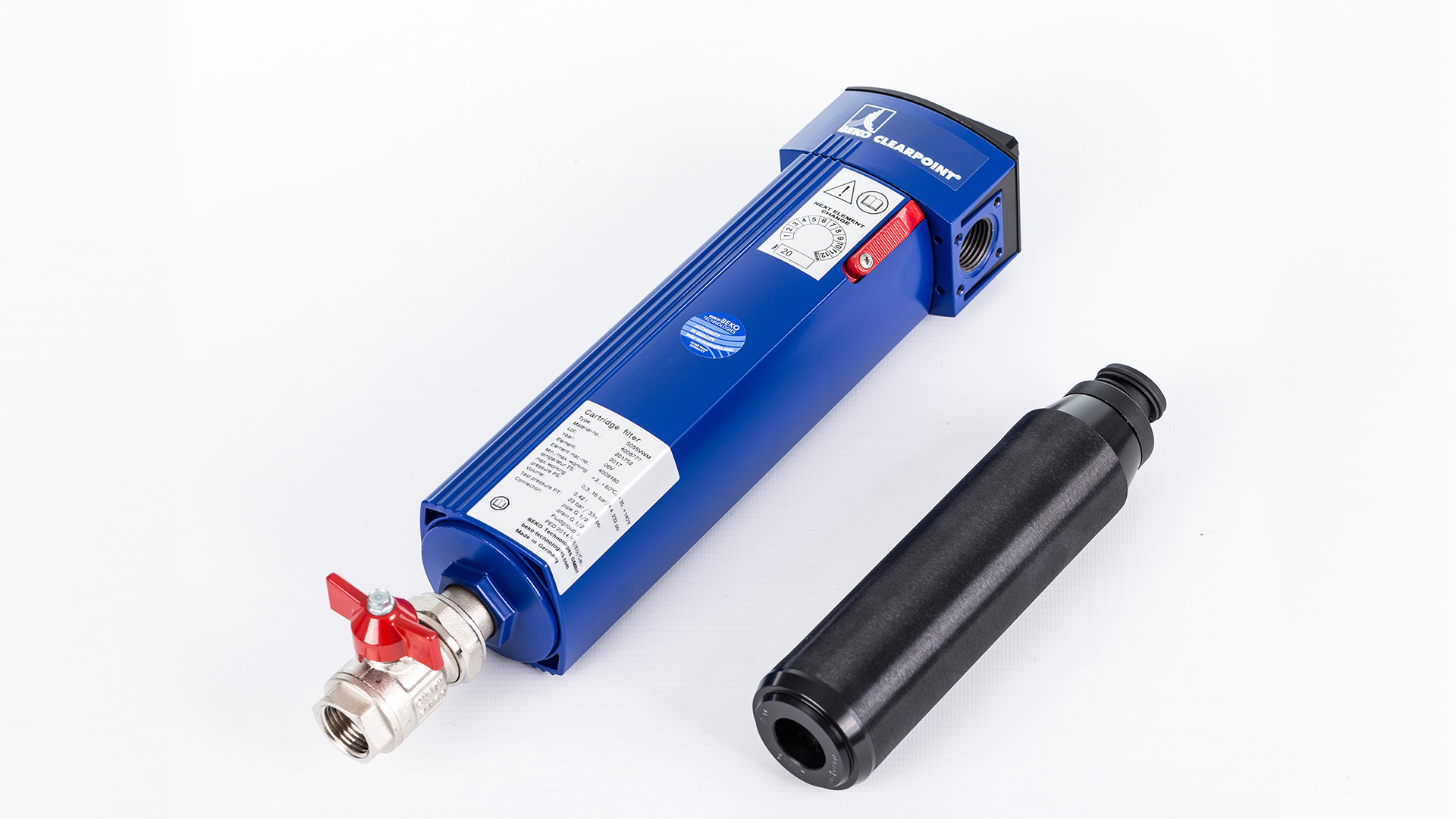
CLEARPOINT® V S/M activated carbon cartridges
CLEARPOINT V activated carbon cartridge for small and medium volume flows
For small and medium volume flows up to 200 m³/h and pressures up to 50 bar [g], our CLEARPOINT V S/M offer a clean solution for oil-free treatment.
A special activated carbon cartridge has been developed for maximum requirement profiles.
- Highly efficient adsorption with minimum residual oil content
- Significantly higher service lives than conventional activated carbon filter elements
- Service-friendly with easy to exchange cartridge
- Conventional testing technology can easily be adapted
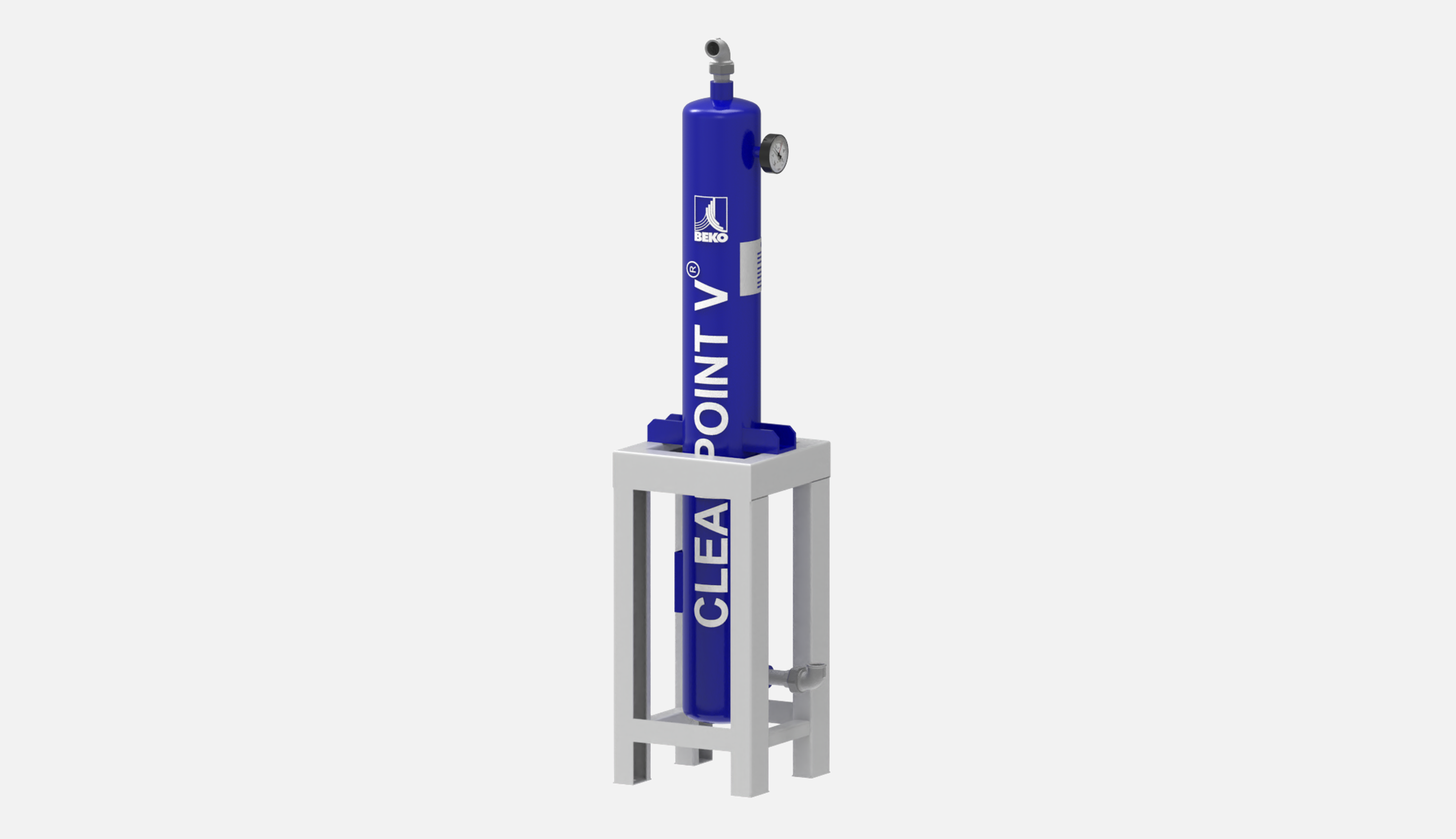
CLEARPOINT® V L activated carbon adsorber
CLEARPOINT V activated carbon adsorbers for large volume flows
The extraordinary range of variants of the CLEARPOINT V L available offer you the suitable solution for every requirement. For volume flows up to 8200 m³/h and pressures up to 40 bar [g].
CLEARPOINT V L is the effective and reliable solution for ensuring a high compressed air quality, particularly in terms of the residual oil content. An indispensable technical component in demanding system designs. Advanced overall design for outstanding performance.
In addition to our standard versions L 205-295 V, L 1250-8200 V for volume flows from 135 m³/h to 8200 m³/h, we also offer a suitable option for the pressure range up to 40 bar in the form of our L 1300-5000 V HP (1300 - 5000 m³/h). If particular care is required in terms of fire protection, we can deliver all models in a VH version on request, which provides a combustion-resistant solution thanks to special carbon.
Model variants & information
Technical data
Service life [h]
Connection
Volume flow rate* 7 bar [g] (m³/h)
Dimensions [mm] (AxBxCxD)
Weight (kg)
Category according to PED2014/68/EU, Fluid group 2
Available versions
S 055
2000 (at 25 °C)
1/2"
50
75x28x265x150
1.5

VWM
M 010X
3500 (at 25 °C)
3/4"
100
100x34x350x150
1.12
VWMX
M 018
3500 (at 25 °C)
1 1/2"
200
146x48x418x160
6
VWM
L 205
10000 (at 35 °C)
G1"
135
1580x340x440x680
65
II
VWM, VIM, V
L 210
10000 (at 35 °C)
G1"
155
1490x340x440x680
95
II
VWM, VIM, V
L 215
10000 (at 35 °C)
G1"
200
1490x340x440x680
95
II
VWM, VIM, V
L 220
10000 (at 35 °C)
G1 1/2"
280
1850x450x590x810
145
III
VWM, VIM, V
L 230
10000 (at 35 °C)
G1 1/2"
500
1810x450x590x810
172
III
VWM, VIM, V
L 240
10000 (at 35 °C)
G2"
630
1980x935x595x1430
240
III
VWM, VIM, V
L 250
10000 (at 35 °C)
G2"
800
1940x935x595x1430
240
III
VWM, VIM, V
L 260
10000 (at 35 °C)
G2 1/2"
1000
1980x1020x700x1305
300
IV
VWM, VIM, V
L 275
10000 (at 35 °C)
G2 1/2"
1250
1980x1020x700x1305
300
IV
VWM, VIM, V
L 295
10000 (at 35 °C)
G2 1/2"
1550
2080x1085x730x1310
380
IV
VWM, VIM, V
L 1250
10000 (at 35°C)
65
1250
2300x700x680
355
IV
V
L 1550
10000 (at 35°C)
65
1550
2270x750x755
420
IV
V
L 1700
10000 (at 35°C)
80
1700
2335x750x805
500
IV
V
L 2000
10000 (at 35°C)
80
2000
2360x850x855
600
IV
V
L 2300
10000 (at 35°C)
100
2300
2480x850x905
670
IV
V
L 2600
10000 (at 35°C)
100
2600
2500x1000x955
750
IV
V
L 2900
10000 (at 35°C)
100
2900
2520x1000x1005
820
IV
V
L 3400
10000 (at 35°C)
100
3400
2540x1000x1055
920
IV
V
L 4200
10000 (at 35°C)
150
150
4200
2810x1100x1030
2810x1100x1030
1120
IV
V
L 5000
10 000 (bij 35 °C)
10000(35°C時)
10000 (at 35°C)
150
150
150
5000
5000
5000
2870 × 1250 × 1130
2870×1250×1130
2870x1250x1130
1370
1370
1370
IV
IV
IV
V
V
V
L 6000
10000 (at 35°C)
150
6000
2930x1250x1225
1630
IV
V
L 7000
10000 (at 35°C)
10 000 (bij een temperatuur van 35 °C)
10 000(在 35 °C 时)
10 000 (a 35 °C)
150
150
150
150
7000
7000
7000
7000
2970 × 1450 × 1345
2970 x 1450 x 1345
2970×1450×1345
2970x1450x1345
1930
1930
1930
1930
IV
IV
IV
V
V
V
L 8200
10000 (at 35°C)
150
8200
3010x1450x1445
2220
IV
V
Facts - Good to know
For the production of compressed air of ISO 8573 quality class 1, most operators use activated-carbon adsorbers that remove oil molecules from the compressed air by means of adsorption. As activated carbon also adsorbs water vapour, it can be quickly spent, especially where the air contains quite a lot of water vapour. At this point, the activated-carbon adsorber is no longer able to take up oil molecules, so that the concentration in the downstream compressed air exceeds the limit for quality class 1 (> 0.01 mg/m³). For long service lives and consistent low residual oil contents, the compressed air must therefore be dried before it enters the activated carbon.

Activated Carbon Adsorbers – Frequently Asked Questions
When is an activated carbon adsorber NOT sufficient?
An activated carbon adsorber such as CLEARPOINT V is ideal for defined residual oil vapour loads under controlled operating conditions.
However, if:
- oil vapour concentrations fluctuate heavily,
- unknown hydrocarbon loads occur,
- or absolute oil-free air must be guaranteed permanently,
a catalytic system such as BEKOKAT may be the more reliable long-term solution.
How can I calculate the service life of activated carbon in my application?
Service life depends on:
- inlet oil vapour concentration
- pressure and temperature
- residual moisture content
- operating hours
As a rule of thumb: the drier the compressed air and the lower the oil load, the longer the service life. A technical evaluation of operating parameters is recommended for precise sizing.
What happens if the residual oil limit of ISO 8573-1 Class 1 is exceeded?
Exceeding the limit defined in ISO 8573-1 (> 0.01 mg/m³ for total oil in Class 1) can lead to:
- Product contamination
- Audit non-conformities
- Production downtime
- Liability risks in sensitive industries
Continuous monitoring or periodic measurement is therefore recommended in critical applications.
Does an activated carbon adsorber remove oil aerosols as well?
No. Oil aerosols must be removed by high-efficiency coalescing filters upstream.
Activated carbon primarily removes oil vapours and odours, which pass through conventional filters.
Proper pre-filtration is essential for reliable performance.
Where should the activated carbon adsorber be installed in the compressed air system?
Best practice installation:
- After compression
- After drying
- After fine and micro filtration
- Before sensitive consumers
This ensures low moisture load and maximises adsorption efficiency.
How can I detect oil breakthrough early?
Possible indicators:
- Rising total oil measurement values
- Odour in compressed air
- Shortened cartridge lifetime
- Increased pressure drop
In critical processes, inline monitoring of residual oil content is recommended.
Is there a fire risk with activated carbon adsorbers?
Under standard operating conditions, activated carbon is safe.
For applications with elevated fire protection requirements, special versions (VH) with combustion-resistant carbon are available.
Downloads
CLEARPOINT V active carbon adsorber

Brochure

254 KB
CLEARPOINT L 205 – L295 VWM
Manual
946 KB
Manual CLEARPOINT S055, M010X, M018
Manual
1 MB